Shipping Ice Cream: Plan Around Product Quality
Shipping ice cream starts with a clear product-quality goal. A box can feel cold even if the dessert has softened. Define the required arrival condition before choosing a cooler, coolant or service.
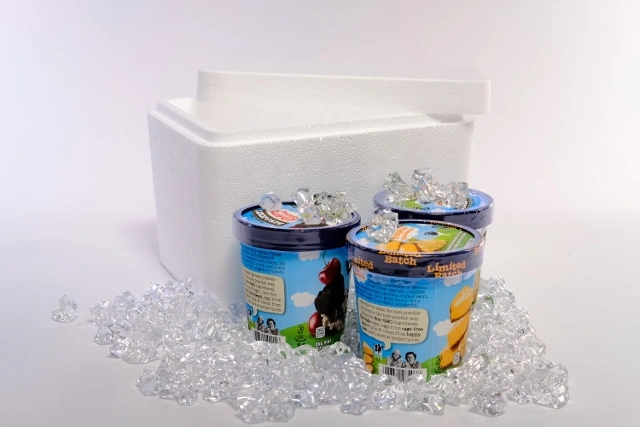
How cold should ice cream stay during shipping?
Use 0°F (−18°C) or colder as a practical frozen-storage benchmark, then set the shipping limit for your actual product. The International Dairy Foods Association’s ice-cream handling guidance identifies that temperature for optimum retail storage and warns that exposure above 10°F (about −12°C) can harm body, texture and flavor. A product can therefore lose saleable quality while still feeling cold.
| Temperature | Meaning for your shipping plan |
|---|---|
| 0°F (−18°C) or colder | IDFA’s optimum retail-storage benchmark; use the manufacturer’s specification to establish your shipment’s limit. |
| 6–10°F (about −14 to −12°C) | IDFA’s serving range for easier scooping. Serving softness is a different goal from preserving a parcel through hot-weather delivery. |
| Above 10°F (about −12°C) | IDFA warns of adverse quality changes. This is not a universal instant-failure threshold; exposure time and formulation matter. |
Commercial distribution may use considerably colder storage. A South Dakota State University ice-cream storage study used −20°F (about −29°C) as its industry-standard comparison temperature. That study is context for deeper-frozen handling, not a universal parcel-shipping setpoint. Get the producer’s specifications for dairy ice cream, gelato, low-fat products or non-dairy desserts; the same softness or melting behavior should not be assumed across recipes.
What warming and refreezing do to ice cream
Ice cream’s smoothness depends partly on small ice crystals. The University of Guelph’s ice-cream technology reference explains recrystallization: warming melts some smaller crystals, and subsequent cooling deposits water onto larger crystals. Repeated temperature swings can leave a coarse, icy texture even when the tub later looks frozen again.
This temperature abuse is often called heat shock. Loading-dock waits, warm vehicles and doorstep exposure can all interrupt the cold chain. Refreezing does not restore the original fine crystal structure. A firm tub at the end of the journey is therefore not proof that quality was preserved throughout it.
Temperature history also affects remaining quality shelf life. There is no dependable rule that a particular warm interval removes a fixed number of days from every ice cream. Formulation, initial quality, packaging and later storage all matter. Investigate excursions against your product’s evidence rather than restarting its shelf-life clock after refreezing.
Freezer burn is different from heat shock
The term for moisture loss from frozen food is freezer burn, rather than frostbite. University of Missouri Extension’s freezing guidance explains that surface ice can pass into water vapor, drying the food and damaging flavor and texture. Freezer burn is a quality defect; it does not by itself establish that food is unsafe.
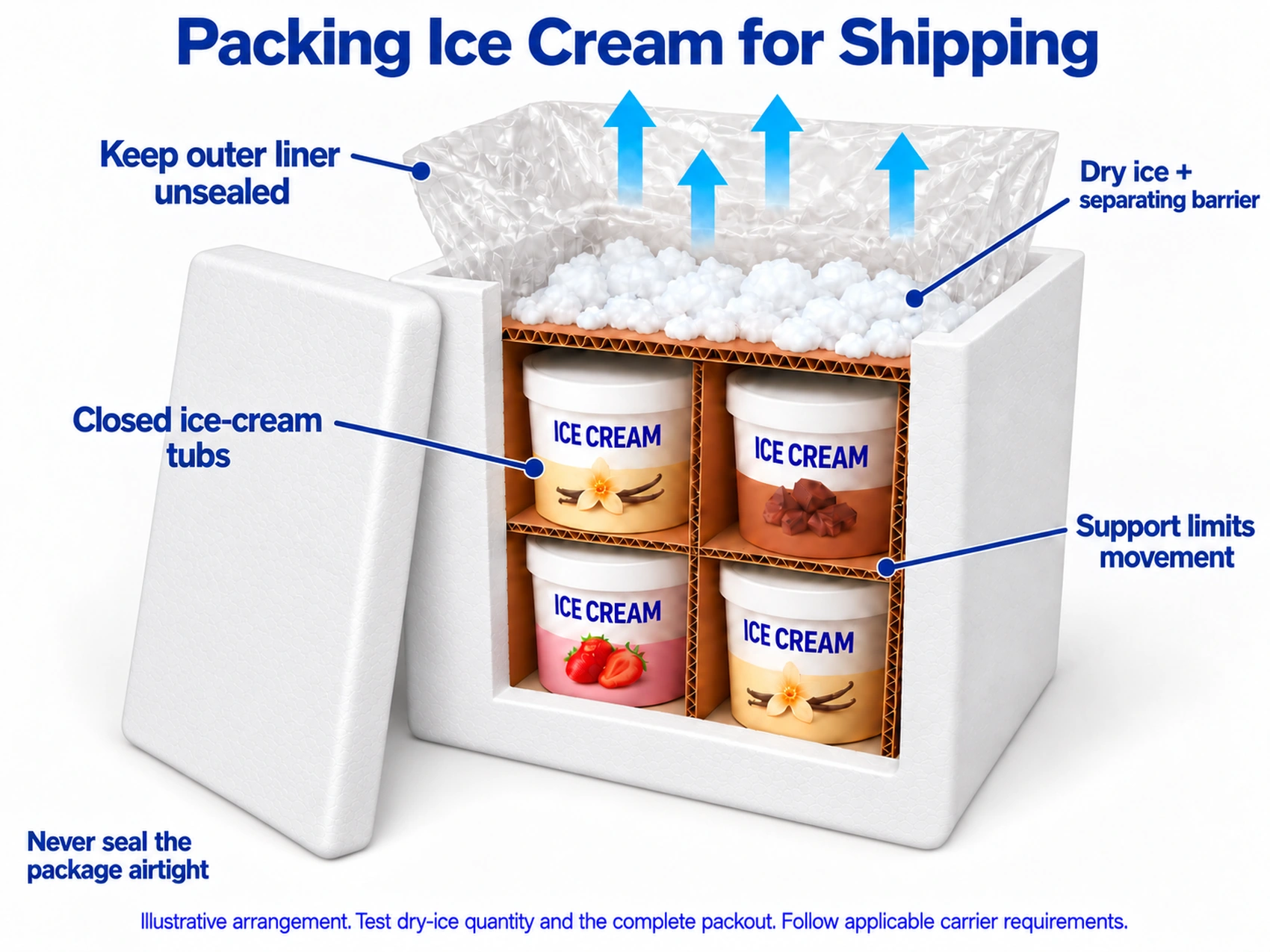
For ice cream, protect the retail container’s lid, seal and moisture barrier. A cracked tub or lifted lid gives the product less protection. Use packaging intended for frozen storage and assess surface drying and ice buildup during quality review. The food container should close securely, but a shipping system containing dry ice must still release carbon dioxide gas. Never seal the cooler or outer parcel airtight.
Pack ice cream for the whole hot-weather journey
- Start fully frozen. Harden and store the product according to the producer’s instructions before packing. Prepare the station, carton, insulation and labels first; bring out only the product you can pack promptly.
- Protect the sale units. Inspect tub rims, lids, film seals and wrappers. Use the supports and separation layers established for the product. Check that lids cannot be pushed open and that novelty bars are not carrying the weight of heavier tubs.
- Fit the complete load. Place the protected tubs, cups or bars in the insulated cooler with room for coolant. Stabilize movement gaps with suitable supports without crushing containers or obstructing required gas release. Close the lid normally; forced closure signals a fit problem.
- Use a coolant arrangement that meets the ice cream’s temperature target. Dry ice is one option for deep-frozen shipping. An ordinary frozen gel pack is not automatically a substitute for a system designed around lower temperatures. Use product-compatible barriers and verify the form, quantity and placement in a loaded trial.
- Close the complete shipping package correctly. Use suitable outer protection, follow carrier closure instructions and preserve gas release when using dry ice. Apply required marks and labels and record the package version and coolant weight at loading.
- Dispatch into a realistic receiving window. Match collection and delivery timing to the tested packout. Avoid preventable weekend holds and arrange prompt receipt. Test the expected warm exposure, including staging and time after delivery, rather than a comfortable indoor room alone.
A starting dry-ice estimate for trials
FedEx’s dry-ice guidance gives a starting planning range of 5–10 pounds per 24 hours and suggests allowance for an additional day of delays. A 24-hour trip plus a 24-hour allowance therefore gives an initial calculated range of 10–20 pounds. This is a trial estimate, not an ice-cream performance guarantee. Check service quantity limits and evaluate the actual cooler, dessert load, dry-ice form and hot-weather exposure.
Use the frozen-food dry-ice quantity shipping guide for the calculation and trial record. Position coolant using the arrangement supported by those trials; a generic instruction to add a block on top does not establish even protection for every tub.
Give the receiver ice-cream-specific instructions
Arrange delivery when the customer can retrieve the parcel promptly. Ask the receiver to follow your product-temperature check, inspect tubs and wrappers, and report melted product, leaks, collapsed shapes or other failed acceptance checks. Give safe instructions for handling remaining dry ice. Photos can document damage, but they cannot reconstruct the temperature history.
Do not tell customers to refreeze melted ice cream to rescue the order. University of Minnesota Extension advises against refreezing ice cream and similar frozen desserts. FoodSafety.gov’s thawed-food chart also treats ice cream and frozen yogurt separately from foods that can generally be refrozen; its instruction is to discard them. The chart concerns power outages, but it is an important reason not to apply generic frozen-food refreezing advice to an ice-cream delivery.
An arrival at refrigerator temperature is not an acceptable frozen ice-cream delivery. Have the customer report an unacceptable or uncertain condition through your stated process, and never ask them to taste the dessert to assess safety. For accepted arrivals, direct them to the product’s required freezer storage immediately.
Evaluate the real retail pack
Test the containers customers will receive. Tubs, small cups and novelty bars need different layouts. Include lids, sleeves and protective inserts when checking fit.
Keep products in their required frozen storage until assembly. Prepare labels and supplies before packing to limit exposure. Record the starting food condition in each trial.
Qualify the cooling arrangement
Choose coolant and insulation for the required product condition. For dry ice, allow gas to escape and follow the handling instructions. Protect food and retail packs from direct contact where the product or supplier requires it.
Test the conditions expected on the route, including planned delays. Review the product after the full window, through receiving. A short successful trial does not prove a longer delivery promise.
Set limits staff can follow
Record approved order sizes, layouts and service areas. Set a review process for orders outside that range. Test changes to the product or package against the same quality goals before routine use.
Inspect more than the outside of the tub
Define the quality checks before the shipping trial. Your quality team may assess bent tubs, leaks, signs of softening and texture. Use a set procedure so each package receives the same review.
Use the same retail format when comparing packages. A large tub, small cups and coated bars create different gaps and pressure points. Photograph the loaded box. Identify the exact product format in the packing instruction.
Review changes to each part of the pack. A new lid or sleeve can affect fit even if the recipe and net weight stay the same. A passing tub trial does not cover every frozen dessert.
For dry-ice systems, follow the carrier's gas-release requirements. Use the frozen-food packaging comparison to evaluate container alternatives.
Keep a useful trial record
Record the food load, cooler, outer box and coolant in each trial. Include coolant weight, form and position. Measure the finished parcel and photograph the layers before closure. The record should let another person reproduce the setup.
Choose monitoring positions before the trial. An item near the lid may face different conditions from one in the center. Review the food measurements with the quality checks. Remaining dry ice is useful context, but it does not prove the condition of every dessert.
Plan for the customer to receive the order
Include packing, pickup and the time after delivery in the protection window. Choose a service that fits the tested plan. A delivery scan does not show when the customer stores the food.
Give customers clear receiving and storage instructions for the product. Provide a contact route for damaged packs or uncertain arrival conditions. Follow the business's food safety process for those reports. Do not use a taste test to decide whether food is safe.
Review an exception before repeating it
If an order falls outside the approved range, use the review process. A different tub count or longer receiving delay may need a new layout or trial. Keep the decision with the test record so staff can apply the same rule next time.
Compare fit for the actual dessert format
Use the frozen-food planning guide for the broader package and service decisions. Send the dimensions of your tubs, cups or novelty packs to the Client Solutions Team. Review LoBoy container options for that load before testing the full package.
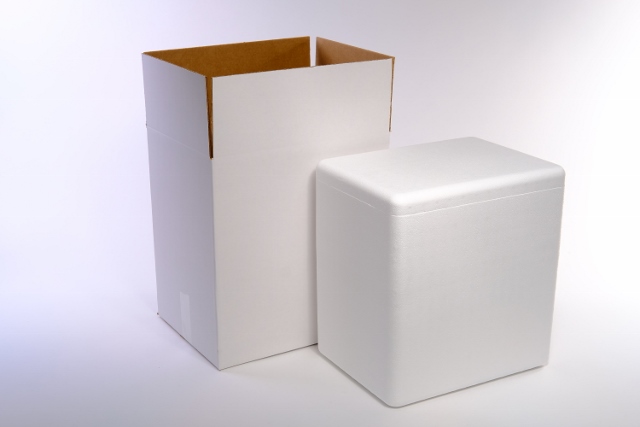
Browse LoBoy shipping coolers